
Canada’s Northwest Passage and the Potential for Co-Management
The legal status of the Northwest Passage remains contested and as the rate of polar maritime traffic continues to increase, the status quo of ‘agreeing to disagree’ becomes more tenuous. Canada asserts that the passage is historic internal waters while the United States understands the passage to be an international strait. This article follows the ‘sovereignty to the side’ thesis and argues that a way Canada can assert its sovereignty and control over the disputed Passage through the creation of a co-management council that would highlight Indigenous knowledge and participation, drawing inspiration from Aotearoa New Zealand’s Whanganui River Council. The proposed Canadian Northwest Passage Maritime Council would have three different bodies (Observatory Body, Advisory Core, and Decision-Making Committee) working together with various levels of authority to help make decisions regarding the management of the Northwest Passage. The proposed Council would not only help to legitimize the Canadian position in the international arena but also demonstrate its commitment to highlighting northern Indigenous voices in Arctic governance and make the Canadian position more favourable.
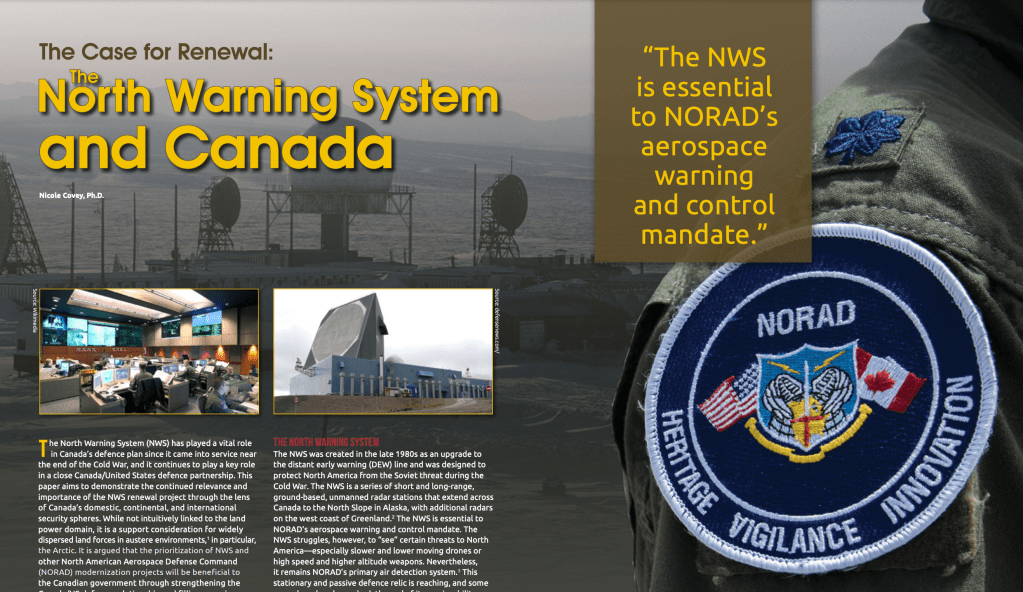
The Case for Renewal: The North Warning System and Canada
The North Warning System (NWS) has played a vital role in Canada’s defence plan since it came into service near the end of the Cold War, and it continues to play a key role in a close Canada/United States defence partnership. This paper aims to demonstrate the continued relevance and importance of the NWS renewal project through the lens of Canada’s domestic, continental, and international security spheres. While not intuitively linked to the land power domain, it is a support consideration for widely dispersed land forces in austere environments, in particular, the Arctic. It is argued that the prioritization of NWS and other North American Aerospace Defense Command (NORAD) modernization projects will be beneficial to the Canadian government through strengthening the Canada/US defence relationship and filling a gap in North America’s (and, by extension, Canada’s) defence system during an era of increasing global tensions.
Arctic SAR and the “Security Dilemma“
Co-authored with Dr. Michael Byers
This article explains how search and rescue (SAR) equipment and personnel can strengthen Canada’s Arctic security without contributing to a classic “security dilemma”—whereby a perceived military buildup by one state leads to a responsive buildup by another state, and so on into an arms race. This is because Arctic SAR involves dual-use assets that can fulfill most existing and reasonably foreseeable Arctic security roles as a secondary mission. Avoiding a security dilemma is key with regards to Canada–Russia relations. In the Arctic arena, Russia sees itself surrounded by North Atlantic Treaty Organization states during a period of considerable tension with those same states elsewhere in the world. Although most of the responsibility for that tension lies with Russia, it is still in Canada’s interest to avoid feeding Russia’s Arctic uncertainties and insecurities, since regional military buildups can cause instability and even conflict.
Conference Reports, Policy Papers, & Activity Reports
Defending the Continent: A Pan-Canadian and Pan-Domain Arctic Approach
Conference Report for the Canadian Global Affairs Institute Conference, “Defending the Continent: A Pan-Canadian and Pan-Domain Arctic Approach”, that was held on May 19 2022.
Legitimization of the Arctic Coastal States (A5) through the Central Arctic Ocean (CAO) Fisheries Agreement
On June 25, 2021, the Agreement to Prevent Unregulated High Seas Fisheries in the Central Arctic Ocean (henceforth referred to as the CAO Fisheries Agreement) entered into force. This primer explains the CAO Fisheries Agreement and how it can be understood as a legitimizing tool for the Arctic Five (A5 – the Arctic littoral states of Canada, the United States, Denmark, Norway, and Russia), in addition to providing a brief background of the tensions that exist between A5 and A8 governance. Despite the Agreement itself being signed by the “A5+5” (the Arctic littoral states plus Iceland, China, Japan, Republic of Korea, and the European Union) through the understanding that the CAO Fisheries Agreement was based off of the 2015 Declaration that was produced solely by the A5, the agreement can still be understood as a legitimization tool for the work of the A5. In a manner similar to how non-Arctic states can take on the role as Observers in the Arctic Council, the “plus 5” of the A5+5 were brought into the CAO fisheries conversation after the Arctic coastal states established the parameters. Thus, the reception of the CAO Fisheries Agreement demonstrates a marked shift and the acceptance and legitimatization of Arctic Ocean governance by the A5 instead of the A8.
The Case for Traditional Security
This brief aims to introduce the key ideas presented in Dr. Rob Huebert’s latest chapter, Understanding Arctic Security: A Defence of Traditional Security Analysis. Over the course of the chapter, Huebert tackles two major questions: “What is the case against using traditional security to understand the modern Arctic security environment? And what contribution could a traditional security framework make?”. In the chapter, Huebert argues that the narrow/traditional security framework is still a viable tool for Arctic research in cases related to national security.
A Resumption of the Great Arctic Game
On October 29, 2020 Dr. Rob Huebert gave a presentation as part of the NAADSN Ideas Series entitled “Did the Cold War Ever End?: The New Arctic Security Triangle Environment.” The presentation was orientated around the questions of “did the Cold War ever end” and “how should we understand the factors driving the Arctic security regime.” When looking at Arctic security, scholars need to avoid falling into simply challenging or accepting the “newisms,” and instead start to pay more attention to the methods and data that scholars are relying upon to draw conclusions. Dr. Huebert’s presentation can be broken into three sections: three hypotheses in regards to Arctic security, his argument that the Cold War never ended, and finally a look at the current status of the Arctic security environment.
Op-Eds
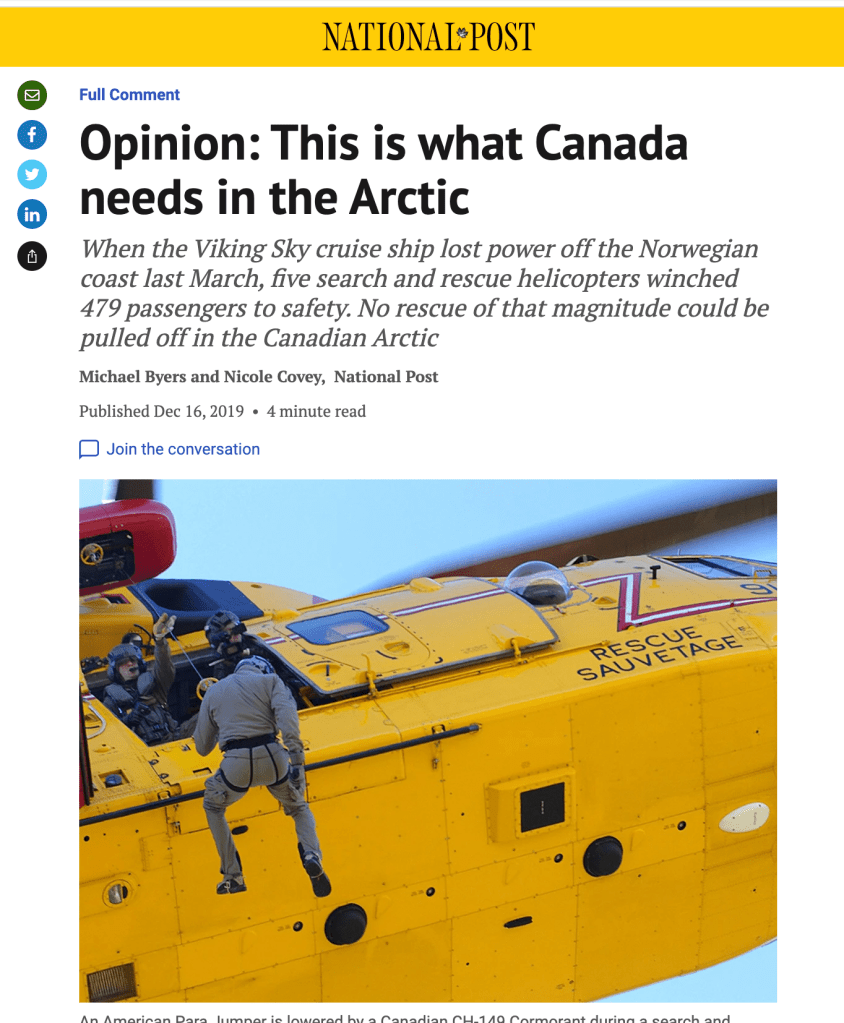
This is what Canada needs in the Arctic
Co-authored with Dr. Michael Byers
This op-ed was published alongside the journal article “Arctic SAR and the “Security Dilemma””.
Master’s Thesis
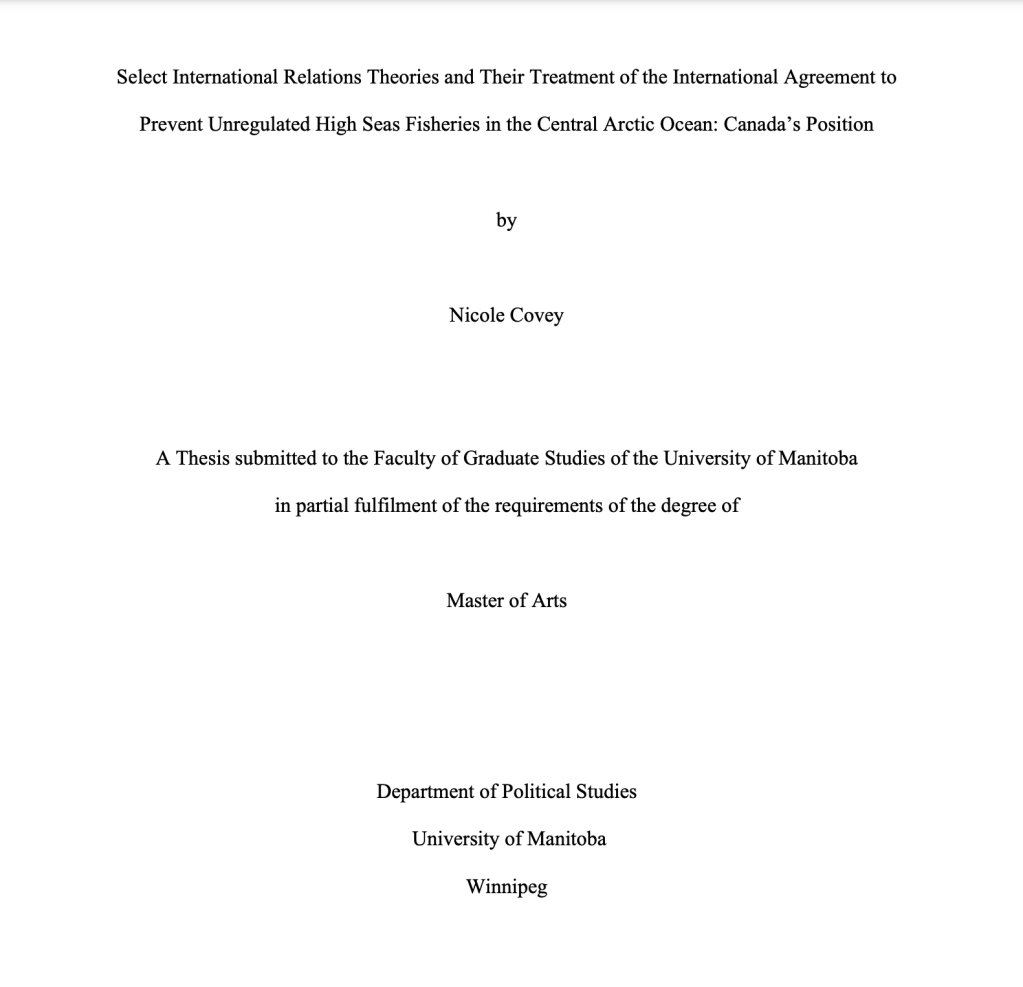
Select International relations theories and their treatment of the International Agreement to prevent unregulated high seas fisheries in the central Arctic Ocean: Canada’s position
This thesis applies four international relations theories to the International Agreement to Prevent Unregulated Commercial Fishing on the High Seas of the Central Arctic Ocean (the Agreement) to determine which theory best explains the Agreement and the Canadian government’s justification for its ratification. Using both Rational (Realism and Liberalism) and Reflective (Constructivism and Pluralism) schools of thought, I ultimately conclude that the English School’s theory of Pluralism provides the best framework for understanding the Agreement and
Canada’s perspective. Pluralism allows for insights into the general reasons for the Agreement’s creation, Canada’s inclusion of the Inuit Circumpolar Council Canada in negotiations and ultimately Canada’s enthusiastic promotion of the Agreement. The other theories, either because of the ontology or epistemology they prefer, can shed light on only parts of the Agreement and/or Canada’s perspective.
 Nicole Covey